
 ▶ Video
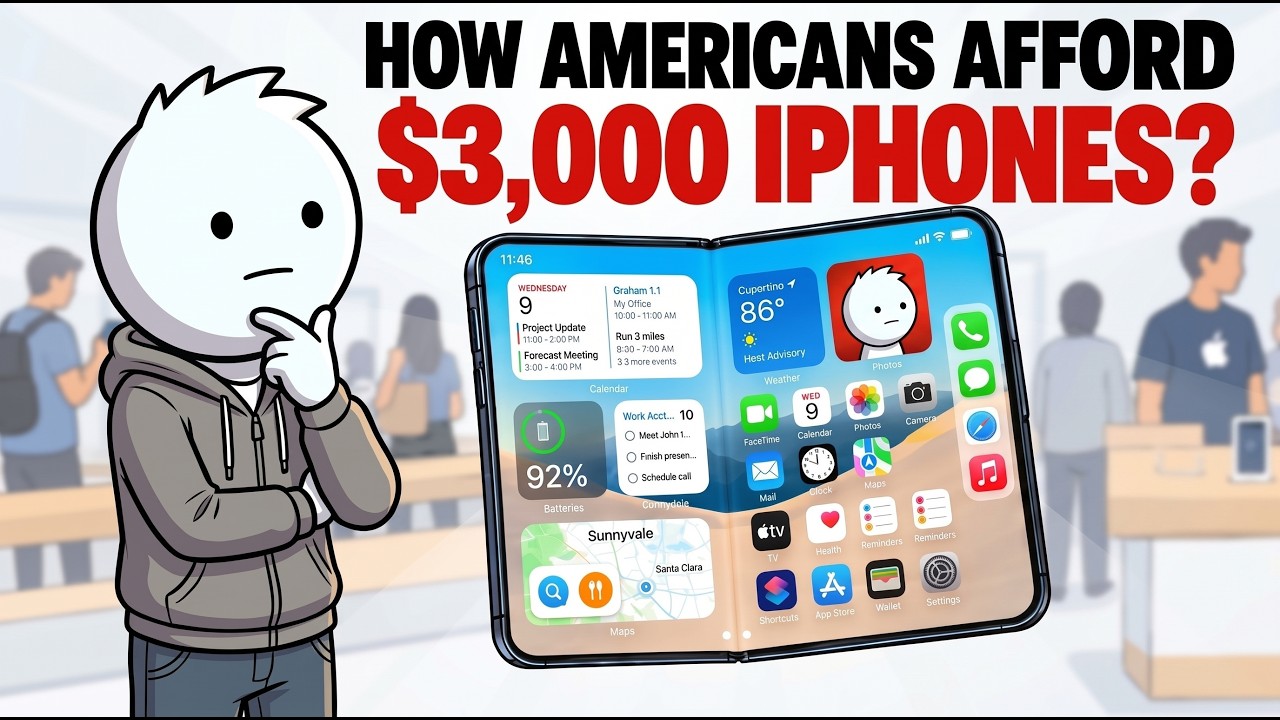
I was scrolling through Apple's own pricing page last week, comparing the sticker price against the number printed right next to it and smaller type. The gap between those two numbers is the entire subject of this video. A fully loaded iPhone Pro Max now clears $1,500 before a single accessory gets added. Apple's newest folding phone starts at $19.99 and tops $3,000 fully speced. Sit with either price for a second, then look at your own paycheck and ask honestly whether you'd hand over that much cash in one motion for a phone. Most people wouldn't. And yet, Apple just posted its best iPhone revenue quarter in company history. Something is closing that gap between the price and what people actually feel able to spend. And it isn't hidden. It's printed directly on the page in a font small enough that almost nobody stops to do the math on it. Meet Diane. Median American household income, $83,730 a year. $6,977 a month before tax. She's looking at a fully loaded iPhone Pro Max at $1,599. Apple doesn't lead with $1,599 anymore. It leads with $66.62 a month for 24 months at 0% APR or roughly $46 a month if she leases it instead through Apple Upgrade and hands it back in 2 years. Run either number against Dian's paycheck. The finance version is. 95% of her gross monthly income. The least version is 66%. To be fair from the start, this is nothing like the $500,000 house or the $80,000 truck. One phone payment doesn't break anybody. The real question isn't whether Diane can afford one payment. It's what happens the moment the phone stops arriving alone. A case for Apple's own foldable phone runs $79, $129 for the version with a cover for the second screen. In a household with more than one adult on the same family plan, the phone itself often arrives twice. Two fully loaded foldables on Apple's 24-month plan run close to $270 a month combined. 3.87% of Dian's gross household income every month for 2 years straight. That's not catastrophic on its own, but it's the first domino. And the entire pricing structure behind it was built by three separate mechanisms. Each one working the same trick, making a real number feel smaller than it is. Apple's 0% installment plan really is 0%. No interest hidden inside that specific monthly number, but three conditions sit in the footnote underneath it that most people scroll past. The plan runs through Apple Card specifically, which means a credit application and a credit limit large enough to hold the full phone price. It requires enrolling through AT&T, T-Mobile, or Verizon at checkout. No other carrier qualifies and taxes and shipping are excluded from the 0% entirely. Apple's own support documentation confirms their build separately at the card's variable rate, which as of mid 2026 runs between 17. 49% and 27.74% depending on creditworthiness. Storage upgrades ride the same psychology. Moving from the base model to the top storage tier adds roughly $1,200 to the sticker price, a number substantial enough to make most buyers pause. Spread across 24 months, that same jump adds about $50 a month, a number people tap past without a second thought. The total cost didn't change, only which number Apple chose to put in front of the buyer's eyes. Carrier trading credit is real money, and Apple's current offers run up to $1,200 with AT&T or T-Mobile. up to $1,20 with Verizon. But that credit rarely lands as a lump sum. It lands as bill credits spread across 36 months tied to staying on a specific qualifying plan the entire time. Divided out, $1,200 spread across 36 months works out to $33.33 a month. Landing within a couple of dollars of what the phone itself costs financed over the identical term. The credit doesn't make the phone free. It cancels the phone payment one month at a time for as long as that exact line stays on that exact plan. Switch plans early or drop the line and the remaining credits typically stop. Here's the detail that makes this durable rather than a one-time trick. Industry data on upgrade cycles has shown the average phone owner keeping a device close to 40 months before replacing it. A 36-month plan commitment isn't asking most people to change their behavior. It's simply attaching a contract to a decision they were already going to make anyway. The newest lever launched in 2026, Apple Upgrade, a leasing program Apple built in partnership with Cla, the company best known for buy now pay later financing. In Apple's own language, this is a consumer lease, not a purchase and not a loan. Pricing starts as low as $17.99 a month for a base iPhone, climbing well past $80 a month for a fully loaded foldable. Run 24 payments at a mid-range lease price of roughly $58 a month. And the total comes to about $1,392, hundreds less than buying the same phone outright. That difference isn't a discount. It's the portion of the phone Diane never actually owns. At the end of the lease, Apple offers three doors. Hand the phone back and walk away, hand it back and sign a new lease on the next model, or pay a purchase fee to keep it. There's a fourth outcome buried further down the terms. Do nothing and the lease rolls monthtomonth for up to six additional months where in payments can increase and a purchase fee still applies at the end regardless. Approval requires a soft credit check, enrollment through one of the three major carriers, and prepaid plans don't qualify. Ending the lease early can trigger a substantial early termination charge. The monthly number goes down, ownership goes away entirely. Apple reported 54.25 billion in iPhone revenue in a single quarter this year, up nearly 22% from the year before, its best iPhone quarter ever recorded. Across the company, quarterly profit landed near $29.8 billion with margins over 50%. Buyers are also concentrating on the newest, most expensive models at a rate that keeps climbing year-over-year, according to independent research firms tracking iPhone sales mix. None of this requires anyone at Apple, a carrier, or a lender to mislead a single customer. Every number on every page is technically accurate. All three simply get paid best when the only number a buyer ever evaluates is the monthly one. Someone always raises this in the comments. iPhones hold their resale value better than almost anything else in electronics, so the sticker price matters less than it looks. That's largely true. Independent resale tracking studies have consistently shown flagship iPhones retaining roughly half their value after a year. The best retention of any major phone brand, premium or otherwise. But flagship isn't one category. A standard Pro Max depreciates on that well doumented curve. Apple's newer, less tested categories don't get that same track record yet. Its first folding iPhone, for example, entered a segment where foldables industrywide have historically lost well over 60% of their value in the first year, more than double a standard iPhone's depreciation. Run $1,999 foldable through that curve, and it's worth roughly $700 to $800 a year later. A loss north of $1,200 in 12 months, even before financing costs are added. The resale argument that genuinely protects a standard iPhone buyer doesn't automatically transfer to Apple's newest, least proven device categories. Follow three people through the same roughly 10-year stretch. Phone prices held flat, and anything not spent on a phone invested at a realistic 8% annual return. Marcus leases a top tier iPhone every two years without exception, handing each one back and signing the next lease immediately. Across 10 years, he pays out roughly $5,500 in lease payments and never owns a single device outright. Priya refuses financing entirely, pays cash, and buys the fully loaded Top Storage Pro Max. specifically because she's paying cash anyway. She replaces it every 40 months, matching the realworld average upgrade cycle. Across 10 years, that's close to $7,700 spent in cash. Phones she owns outright the entire time. Diane buys the base Pro model that actually fits her needs, finances it on Apple's genuine 0% plan, pays it off in 2 years, and then keeps using the same phone for another 18 months before upgrading. Across 10 years, she spends roughly $2,900 total, less than half of what Priya spent and about half of what Marcus paid. Invested difference at 8% account for capital gains tax on the growth. And Diane finishes roughly $5,000 ahead of Marcus and over $10,000 ahead of Priya after 10 years. Not because she's disciplined in some extraordinary way, but because she asked one question neither of the others asked first. Not what does the phone cost and not what's the monthly payment, but what does it cost for every month I actually use it. Marcus isn't foolish. He always has the newest fold. And if he genuinely upgrades every single year without fail, the math on that specific habit lands close to what the phone would have lost in value anyway. Priya isn't foolish either. She owes nothing to anyone, and no lease can quietly roll over on her. Neither of them ran the number that actually decides this. The phone was never the real problem. Not the $2,000 price, not the $3,000 version, and not the $8 gap between one monthly plan and the other that makes the whole thing feel almost weightless. The only number that ever mattered is the one nobody bothers to calculate before signing. If this change how you'll look at the next phone upgrade page you open, hit like, subscribe, and drop a comment. Are you team Diane, team Priya, or team Marcus?