
15 Toxic Kitchen Items Americans Use Every Day
Key Takeaways: The Japanese Bathroom Philosophy
Japanese bathroom design doesn't rely on more cleaning products or magic gadgets. Instead, it focuses on simple systems that prevent moisture, eliminate clutter, and keep surfaces dry before grime can ever build up.
What if some of the things you use in your kitchen every single day are not as harmless as they look? That scratched non-stick pan, that plastic container you microwave your leftovers in, that black spatula sitting next to your stove, even the cutting board you've been using for years. Most of these things look completely normal, and some of them are perfectly safe when used correctly. But heat, scratches, age, and the wrong type of material can change the equation. And this is where Japanese kitchens take a surprisingly different approach. Instead of simply asking, "Does it still work?" They often ask, "Is this still the right thing to use?" Today, we're looking at 15 common kitchen items and habits that may deserve a second look and the Japanese alternatives and systems that can make your kitchen safer, simpler, and easier to manage. And wait until you see
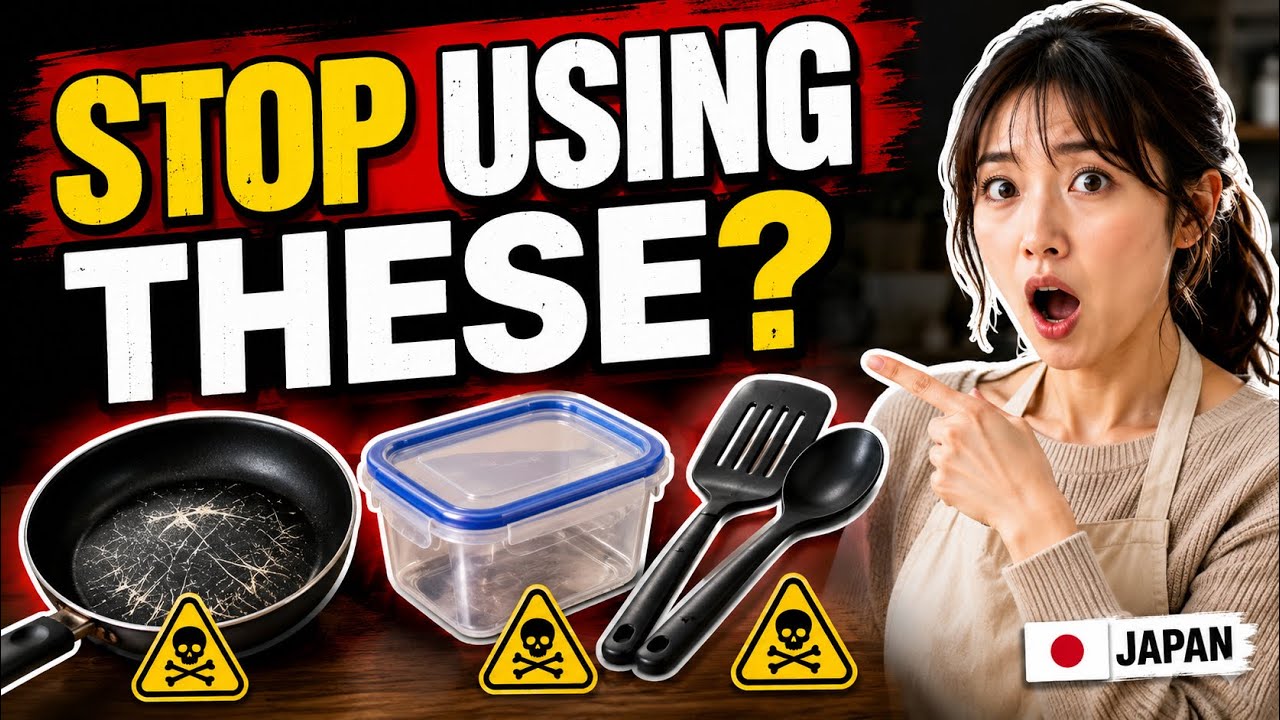
It isn't a single product. It's a kitchen habit that could be hiding in plain sight. One, non-stick pans used at excessive heat. Let's start with one of the most common items in any kitchen, the non-stick pan. It's convenient, easy to clean, and perfect for delicate foods. But there's a problem. Non-stick cookware isn't designed for unlimited heat. Leave an empty pan over high heat, and its temperature can rise surprisingly fast. This is where the Japanese approach is interesting. Instead of asking one pan to do everything, match the cookware to the job. Delicate foods, use nonstick. High heat cooking, choose cookware designed for higher temperatures. The lesson isn't to throw away your non-stick pan. It's simply this. Know its limits and use it for the job it was designed to do. Two, scratched non-stick cookware. Now, look at your old non-stick pan. Still using it. Maybe the surface is scratched. Maybe the coating looks worn and you keep it because it still works. But that's not the only question. If the coating is heavily damaged, peeling, or the pan no longer performs properly, it's time to reconsider it. This is where the Japanese mindset can help. Instead of waiting until something completely breaks, pay attention to when it stops doing its job well. That's a simple principle. Inspect, maintain, replace when necessary. You don't need to fear every tiny scratch. Just don't confuse still usable with still worth using. And next, we're putting something even more questionable into the microwave. Three plastic containers in the microwave. You take yesterday's leftovers, put the plastic container straight into the microwave, and 2 minutes later, dinner is ready. But ask yourself, was that container actually designed to be heated. Not all plastic containers are made for microwave use. Heat, food, and oil can change the equation. So, don't think never microwave plastic. Think know what you're microwaving. Check the label. Follow the manufacturer's instructions. And in a Japanese-style food storage system, containers are chosen around the entire routine. store, see, label, heat. Heat resistant glass can also be a practical option when it's specifically designed for heating. The point isn't to eliminate plastic. It's to use the right container for the right job. Four, old plastic food containers. Open your kitchen cabinet. You probably have one. A container that's scratched, another that smells strange, one that's slightly warped, and at least one with no matching lid. You keep them because they still work. But a container has a job. It needs to seal properly, stay clean, and protect your food. When it's badly damaged, it's time to let it go. Japanese organization offers a simple solution. Standardize your containers. A few sizes, stackable shapes, easy to see, easy to replace. When one reaches the end of its useful life, replace one, not the entire cabinet. That's the power of a system. Fewer containers, less clutter. And now, let's look at something you probably touch every time you cook. Five black plastic cooking utensils. a black spatula, a black ladle, a black cooking spoon. They look completely ordinary, but here's a question you probably never ask. What's actually in that plastic. A 2024 study found flame retardants in some black plastic consumer products tested in the US, including certain kitchen utensils. But that doesn't mean every black spatula is dangerous. The color isn't the problem. The question is the material and where it came from. This is where the Japanese approach offers an interesting alternative. Wood, bamboo, ceramic, and stainless steel are common, simple materials in Japanese kitchens. You can see what you're using. And when the tool becomes damaged, you know it's time to replace it. The lesson, don't just choose a kitchen tool because it's cheap. Know what you're putting in contact with your food. Six. Melamine plates and bowls. You may have seen these before. Lightweight plates, colorful bowls, almost impossible to break. That's exactly why melamine became so popular. But here's the catch. Melamine isn't the same as ceramic. It can be useful for serving food, but it's not meant to replace heat resistant cookware or dishes in every situation. The Japanese approach is simple. Choose the material based on the job. Hot soup, use a suitable ceramic bowl. High heat, use cookware designed for it. Melamine, keep it within its intended use. The lesson isn't melamine is toxic. It's convenient doesn't mean suitable for everything. And the next item shows why even something as ordinary as a plate can deserve a closer look. Seven. Plastic cutting boards. Here's something you probably use every day, your cutting board. Plastic boards are cheap, lightweight, and easy to clean. But every time your knife hits the surface, it can leave tiny grooves. Over time, those grooves can become harder to clean. And researchers have also raised concerns about microlastic particles released from plastic cutting boards during cutting. So, what's the Japanese alternative. A simple wooden cutting board. Japanese kitchens have traditionally used wooden boards because they're practical, gentle on knives, and easy to replace when they become heavily worn. But there's an important point. No cutting board is maintenance-free. Wood needs cleaning and proper drying. Plastic needs replacing when it's heavily worn. The goal isn't to find a magical perfect board. It's to recognize when the tool you're using has reached the end of its useful life. Eight, aluminum cookware. Aluminum cookware is everywhere. It's affordable, it's lightweight, and it heats up quickly. So, what's the concern. Not simply the fact that it's aluminum. The bigger question is what you're cooking in it and how you're using it. Acidic foods, long cooking times, and damaged cookware can all change how materials interact with food. This is where Japanese cooking offers a useful principle. Different jobs need different tools. You don't need to fear aluminum. Just don't assume one material is ideal for every dish. Choose cookware according to the food, the heat, and the cooking method. Because a smart kitchen isn't about finding one perfect material. It's about using the right material for the right task. And that becomes even more important with our next cookware. Nine. Unlined copper cookware. Copper cookware looks beautiful. And there's a reason professional cooks love it. Copper transfers heat extremely well. But there's a catch. Copper shouldn't simply be treated like ordinary stainless steel. When bare copper comes into contact with certain acidic foods, copper can migrate into the food. That's why copper cookware intended for these uses is commonly lined with another material such as stainless steel or tin. And here's the Japanese lesson. Know the material beneath the surface. A beautiful pan isn't automatically the right pan. Before you use specialty cookware, know what it's made from and what foods it's designed for. It's a small detail, but in a kitchen, small details matter. And our next item has an even bigger problem. You may have no idea what it's actually made of.

1
Unknown or lowquality ceramic cookware
Ceramic looks safe, natural, traditional. But here's the problem. Ceramic doesn't automatically mean risk-free. The concern isn't the ceramic itself. It's the glaze and the materials used to make it. Some improperly made or older ceramic cookware and table wear can contain lead or other unwanted substances that may migrate into food. So, don't judge a dish simply by how beautiful it looks. Check the manufacturer. Look for products intended for food use. And be especially careful with old, damaged, handmade, or unknown source pieces. This fits perfectly with a Japanese kitchen principle. Choose fewer things, but know what you're choosing. A beautiful bowl isn't valuable just because it looks traditional. It should also be appropriate for the food you're putting inside it. Because what touches your food matters.
1
Greases food packaging
Here's something you probably don't think about. The paper touching your food. That wrapper around your burger. The paper holding fried food. The packaging designed to keep grease from soaking through. It looks harmless, but some greaser resistant food packaging has raised concerns because certain coatings may contain PFAs, a group of chemicals known for their resistance to grease and water. The important part is this. Not every food wrapper contains PFAS. So, don't panic every time you see a paper package. Instead, pay attention to what you're using and how often you're relying on disposable packaging. This is where the Japanese approach makes sense. Use a proper plate. Use a reusable container and reduce unnecessary layers between your food and the material surrounding it. Less packaging, less waste, less guesswork. And the next item is something many kitchens use every single day.

1
Plastic food wrap used with heat
Plastic wrap is incredibly convenient. Cover a bowl. Wrap leftovers. Put them in the refrigerator. Done. But problems can start when convenience goes beyond its intended use. Not every plastic wrap is designed for heat. and using it with hot food, ovens, or microwaves without checking the instructions can be a mistake. The Japanese solution isn't complicated. Instead of relying on plastic wrap for everything, use a combination of litted containers, reusable covers, and proper storage vessels. The advantage is bigger than just reducing plastic. You create a system. Food goes into a container. The container gets labeled. Then it goes straight into the refrigerator or freezer. No wrapping, no guessing, no pile of half-used plastic wrap. The best kitchen system removes unnecessary steps. And that brings us to another everyday source of plastic.
1
Disposable plastic bags
Small plastic bags seem harmless. One for sandwiches, one for leftovers, one for snacks, and another one just in case. The problem isn't that one plastic bag will suddenly make your kitchen dangerous. It's the habit of using disposable materials for tasks that could easily be handled another way. Japanese kitchens often emphasize compact, reusable storage. A small container can replace multiple bags. It can be washed, stacked, labeled, and used again. That changes the equation. Instead of asking, "What can I put this food in." You already have a system this size for this type of food. This container for this purpose. It's a small change, but repeated every day, it makes a big difference. And now we get to one of the most overlooked problems in the kitchen.

1
Damaged kitchen tools
Your spatula has a cracked handle. Your cutting board is deeply grooved. Your wooden spoon is splitting. And that old utensil, it's slightly burned. But you keep using it because technically it still works. This is where the Japanese philosophy of careful maintenance becomes useful. A kitchen tool doesn't need to be completely broken before you replace it. Look at it, check it, clean it, and when it can no longer perform properly, let it go. The goal isn't to constantly buy new things. It's actually the opposite. Buy fewer tools, choose durable ones, take care of them, and replace them only when necessary. That's a much smarter system than filling your kitchen with cheap replacements. And finally, we arrive at the biggest problem of all. It isn't a product, it's a habit.
1
The use it until it breaks habit
This may be the most important item on the list because every kitchen has things that people keep using simply because they're still usable. An old pan, a damaged container, a worn cutting board, a cracked utensil. None of them looks like an emergency, but together they create a kitchen where nobody really knows what should stay and what should go. And this is where the Japanese approach becomes powerful. Don't wait for failure. Inspect your kitchen before something fails. Ask, "Is this still safe for its intended use. Is it still cleanable. Is it still performing properly. And most importantly, would I buy this again today." If the answer is no, maybe it doesn't belong in your kitchen anymore. Because a well-designed kitchen isn't filled with the most products. It's filled with the right products in the right condition, used for the right purpose. And that may be the real Japanese lesson. Don't simply organize your kitchen. Design it so there's less to worry about. After looking at all 15 items, there's one thing you should notice. The problem isn't simply plastic, non-stick pans, or ceramic. It's how we choose them, how we use them, and how long we keep them. And that's where the Japanese approach offers a useful lesson. Choose carefully. Use things for their intended purpose. Maintain what you own and replace it when it no longer does its job. You don't need to throw away your entire kitchen. You don't need to buy the most expensive cookware. You simply need to know what touches your food and why. Because a smarter kitchen isn't necessarily the one with the newest products. It's the one where every item has a purpose, every material has a reason, and nothing stays simply because you're afraid to let it go. That's not just a cleaner kitchen, it's a better system.

Summary: The Conventional Habit vs. The Japanese System
| Bathroom Routine | Conventional Habit | 🇯🇵 Japanese System |
|---|---|---|
| Shampoo & Soap Storage | Sitting on shower ledge | Elevated hanging draining racks |
| Bath Towel Material | Thick fluffy plush towels | Lightweight quick-drying Tenugui weaves |
| Toothbrush Drying | Stagnant cup on sink counter | Wall-mounted vertical individual clips |
| Personal Hygiene | Disposable flushable wipes | Warm water Bidet / Washlet spray |
| Cleaning System | Deep clean with 10 chemical bottles | 1-minute daily preventative micro-wipe |
Which Item Will You Remove First?
Creating a cleaner bathroom isn't about buying more products. It's about designing a space that stops dirt and moisture before they start!